

The Butter Steak
What’s the best way to cook a steak? For me it has generally involved high temperatures on a charcoal grill, or searing in a cast iron skillet and finishing underneath the broiler, set on High. With some nice, fresh Ribeyes needing to be cooked tonight, I was searching the internet for guidance. In the eGullet forums, I found a better way of doing it.

The poster quoted famous French chef Alain Ducasse in a NY Times article from 2002 in which he compared his method of cooking steaks to the typical high heat Midwestern way of doing it.
I’m not interested in carbonizing the surface of the meat. To me that ruins the flavor.
Instead of hellish temperatures, and visible flames, this article claimed that the best way to cook a steak was over medium heat in a skillet bathed in butter. This more moderate approach allows for even cooking and a great flavor because of the Maillard Reaction. Suddenly my simple meal of modest Ribeye and potatoes required a science lesson.
This technique requires a little more care. The steak is first cooked on its edge to render some of the beef fat and lubricate the pan, then flipped onto its side and cooked in its own fat for a few minutes. Then the fat is poured out and a lot of butter is added. A LOT of butter.
I had my doubts. I worried that the relatively long cooking times would mean the steaks would cook past medium rare. I worried that all I was going to taste was butter. And mostly I worried I hadn’t been gluttonous enough. Ducasse recommended a steak that was 24 ounces and an inch and half thick. The one I picked up was only 16 ounces and only an inch and a quarter, which is still more than I need to eat on a normal night.
I adjusted the cooking times, hoping that I could still get a nice a rare steak, but I was just a little off. Mine got just a tad too close to medium, which makes me wonder whether this technique is only good at cooking insanely big steaks. But I think the technique is right. Next time I might start with butter sooner in the process, flip more often, and pay just a little more attention to it. Because once you see this crust, man…it’s hard to look away.
The Butter Steak Technique
- 2 16-ounce Ribeye
- 4 tablespoons butter
- 4 cloves garlic
- salt and pepper
I set an iron skillet over medium heat. Then I set the ribeye on its fatty edge upright in the skillet.

I cooked it for about 5 minutes until it had rendered a decent amount of fat.
I flipped it on to one flat side and cook it for about 5 minutes. Then flipped it and cooked it for about 3 more.

I removed the steak, poured off the beef fat, and added the butter and garlic.
The steak was returned to the skillet on the side it had cooked on the least, sprinkled with salt, and cooked for about 6 minutes. During that time I basted it continuously with the butter. Then I flipped it, sprinkled that side with salt, and cooked it for about 3 minutes continuing to baste it with butter.
It then rested for about 10 minutes. Ducasse’s rule of thumb is that it need half as long as it takes to cook the meat. It was seasoned with more salt and pepper and sliced up.

As you can (sort of) see, I cooked mine just a tad too much. The middle is past red and into a muted pink territory. There is a definite band of pink though and the crust excellent.
Obama Drastically Scales Back Goals For America After Visiting Denny’s
From The Onion:
President Barack Obama had such high hopes for America…until he went to Denny’s. Now he’s aiming less for being a world leader and setting more reasonable goals for the American people:
Before we reclaim global leadership, we must first stop eating six sausages and a pound of eggs covered in syrup for breakfast, and we must stop leaving the house in sweatpants.
Is he asking for too much? Would you be willing to give up your mountainous plate of syrup-drenched sausages and eggs? Only time will tell.
(Warning–the following video has some rude language.)
Obama Drastically Scales Back Goals For America After Visiting Denny’s
National Doughnut Day

Today, Friday, June 5, 2009, is National Doughnut Day. Not sure why, exactly, but it is a good excuse to make an important decision: plain, sugared, or chocolate-covered. Get’em and eat’em fresh. (But just one. That’s enough. Stop.)
Garden Portraits: Rude Asparagus
I had the pleasure this evening of photographing the most beautiful organic garden I have ever seen. Laura Simon lives in Wauwinet with her husband, Renaissance man Jim Gross, in an idyllic setting of fresh vegetables, beautiful flowers, tupelo blossoms and their attendant honeybees, squawking chickens, and inquisitive dogs. It’s early in the season and many seedlings are just setting their roots. But one bed is in full production. As Laura puts it, “the asparagus are at their peak rudeness.”

I doubt I will ever have the patience to grow my own asparagus. Instead of planting a seed and eating the harvest a few months later, you have to give an asparagus bed 3, or even 4 years, to establish a network of roots and store huge quantities of nutrients and energy in order to produce its delicate, nutritious spears. Even when mature, the bed produces a low weight yield per square yard, and for only 6 to 8 weeks a year. If I read Mrs. Simon’s book correctly, the asparagus bed I was photographing tonight is over 20 years old.

Unless you boil the flavor out of them (and it doesn’t take long to do this), it’s hard to go wrong preparing asparagus for the dinner table. You can steam them for 5-6 minutes and serve them with your favorite vinaigrette and some chopped, fresh chervil. Or you can dry-grill them in a grill pan until they’re nicely marked and then treat them with lemon juice, olice oil, and parmesan cheese. One of my favorite ways of serving them is to preheat the oven to 425 deg., wrap the stalks in pancetta with the tips poking out, drizzle with a little olive oil and roast for about 10 minutes (until the pancetta is crispy). Soft-boil some eggs in lightly salted water for about 5 minutes, cut off the tops, put the eggs back in the egg carton and serve with 2-3 spears per egg (for dipping) and salt and pepper.
Here are more recipes from the NY Times.

Here’s a link to Laura’s book, written in 1998, and still frequently showing up in Best Garden Reads lists online: Dear Mr Jefferson: Letters From a Nantucket Gardener. I look forward to spending more time in her garden, as the season progresses.

Redbox Suggestion
We recently watched an old favorite movie and I want to offer it as a suggestion the next time you’re standing in front of the redbox and are not sure what to rent. Released in 1996, Big Night was directed by Campbell Scott and Stanley Tucci, and starred Tucci and former Wings star Tony Shalhoub.

The film, presumably set in a small town on the New Jersey Shore in the 1950s, tells the story of two immigrant brothers from Italy who own and operate a restaurant called “Paradise.” One brother, Primo (Shalhoub), is a brilliant, perfectionist chef who chafes under their few customers’ expectations of “Americanized” Italian food. Their uncle’s offer to return to Rome to help with his restaurant is becoming more and more appealing to Primo. The other brother, Secondo (Tucci), is the restaurant’s manager, who is enamored with the possibilities presented by their new endeavor and life in America. Despite Secondo’s efforts and Primo’s magnificent food, their restaurant is failing. (VIA)
Here’s a classic scene from the movie.
Once you’ve seen the movie and you decide you want to make the Timpano Alla Big Night recipe, you can do so with the help of the similarly entertaining cookbook from Tucci’s mother, whose skills and stories no doubt influenced the movie. The book is called Cucina & Famiglia and it is available here.

Cherry Buttermilk Cake
It’s Sunday. And a holiday weekend. Time to bake. This cake started as a recipe in Gourmet magazine, June, 2009, as a raspberry cake. I found it on the excellent food blog Smitten Kitchen. (One quick word of warning, it you forget the name of this blog, and you Google it, and you absent-mindedly enter “smitten kitten” in the search field while your wife is half-watching, you will have some explaining to do if she looks over and sees the search results. I’m just saying.)

I decided to modify this recipe and use the fresh, fresh, fresh cherries that are in the local supermarkets. My experience with this cake (haven’t made it but once) makes me believe that you could substitute any round berry-like fruit.
Cherry-Berry Buttermilk Cake
2 cups all-purpose flour
1 teaspoon baking powder
1 teaspoon baking soda
1/2 teaspoon salt
1 stick unsalted butter, softened
1-1/3 cups plus 3 tablespoons sugar, divided
1 teaspoon pure vanilla extract
1 teaspoon finely grated lemon zest (optional)
2 large eggs
1 cup well-shaken buttermilk
2 cup fresh cherries

Preheat oven to 400°F with rack in middle. Butter and flour two 8-inch round cake pan.
Whisk together flour, baking powder, baking soda, and salt and set aside. In a larger bowl, beat butter and 1-1/3 cup sugar with an electric mixer at medium-high speed until pale and fluffy, about two minutes, then beat in vanilla and zest, if using. Add eggs and beat it up.
At low speed, mix in flour mixture in three batches, alternating with buttermilk, beginning and ending with flour, and mixing until just combined. Spoon batter into cake pan, smoothing top. Place cherries evenly over top and sprinkle with remaining 1-1/2 tablespoons sugar.
Bake until cake is golden and a wooden pick inserted into center comes out clean, 20 to 25 minutes. Cool in pan 10 minutes, then turn out onto a rack and cool to warm, 10 to 15 minutes more. Invert onto a plate.


Pierce Street Vegetarian Chili
One of my favorite food blogs is Heidi Swanson’s 101 Cookbooks. She recently posted a recipe for a vegetarian chili that she was very enthusiastic about, that she called Pierce Street Vegetarian Chili. Here’s my take on it.

Ingredients:
2 tablespoons olive oil
1 large yellow onion, chopped
2 shallots, chopped
8 small/med garlic cloves, finely chopped
1 tablespoon ginger, peeled and grated
3 tablespoons chili powder
1 teaspoon ground cumin
1 serrano pepper, seeded and finely chopped
1 chipotle pepper (from can or rehydrate), minced
1 28-ounce can of crushed tomatoes
10 cups vegetable broth
1 1/2 cups cooked chickpeas (canned is fine)
2 1/4 cups black, brown, and/or green lentils, rinsed and picked over
2/3 cup pearled barley or pearled farro
2/3 cup bulgur wheat
1 teaspoon fine grain sea salt (or to taste)

Instructions:
In a large stockpot pot over medium heat add the olive oil, onion, and shallots. When the onions soften up and get a bit translucent, add the garlic, ginger, chili powder and cumin. Stir well and cook for a minute of so, until everything gets quite fragrant. Stir in the serrano pepper and chipotle pepper, tomatoes, and 8 cups of the broth. Now add the chickpeas, lentils, barley/farro, and bulgur – stirring between each addition. Bring to a boil, then reduce the heat to low and simmer. Take a taste of the broth a few minutes into the simmer – you can make adjustments for salt here – if you’re using water in place of broth, you can add a teaspoon of salt for starters and add more later if needed. Simmer away for about 35- 45 minutes or until the lentils and grains are cooked through. You will likely need to add the rest of the water, a cup at a time, if the chili thickens up too much. Before serving do your final adjustments – add more chipotle, salt, or whatever you think it needs and enjoy!
This makes a huge pot of chili. Would serve 12 (at least).

Notes:
We topped it with some crumbled queso fresco and a drizzle of olive oil, but you could top it any number of ways. Some fresh cilantro, feta cheese or goat cheese. Chopped onions. Maybe a little dollop of greek yogurt.
This is good. And, for chili, quick and easy. It has just the right amount of heat. I imagine this will be even better tomorrow. When I make this again, it will fun to vary it a little. Might be nice to add some finely grated carrots. Maybe substitute black beans for the chickpeas. I liked the idea of the ginger, thinking it would be a nice twist on the flavor of chili, but the truth is, I didn’t really taste it. Next time, I will either increase the amount a bit, or just leave it out. I imagine there are several ways to use this as a leftover. I look forward to putting some in a oven-safe bowl, making an indention on the top, cracking an egg in it, and then baking it until the egg is set. Would also be good used as in a burrito.
Nutritional data:

Hospital Food
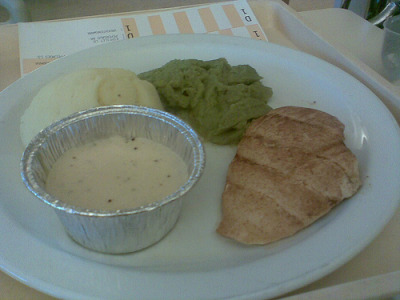
Here’s a link to Hospital Food, a new blog that collects pictures of healthy, healing meals from hospitals from around the world.
Almost No Knead Bread
Nothing smells quite like bread baking in your own oven. But, other than a short-lived bread machine I received as a Christmas gift back in college, I have never really attempted to bake my own. A couple of years ago I saved a bookmark on Mark Bittman’s NYTimes blog “Bitten” for a recipe for “No-Knead Bread” that promised perfect, yet easy to make bread. Basically, it takes time, but little thought.
Today I baked my first loaf, modifying the recipe a little using some guidance from a Cook’s Illustrated magazine article.
And it will not be the last!

“Almost No-Knead Bread”
-
3 cups unbleached all-purpose flour
1/4 teaspoon instant yeast
1-1/2 teaspoons salt
3/4 cup plus 2 tablespoons (7 oz) of room temp. water
1/4 cup plus 2 tablespoons (3 oz) of mild-flavored lager
1 tablespoon white vinegar

The secret to this recipe is using a pre-warmed cast-iron Dutch oven to cook the loaf in after leaving it to rise for 12-18 hours. The original recipe called for the flour, yeast, salt and water only. But some complained that, while easy to do, the flavor lacked a little complexity. Cook’s Illustrated modified the recipe by adding the beer–lager, specifically for reasons related to how this beer is fermented, contains flavor compounds similar to those in the dough starter, and boosts the flavor of the bread–and a little vinegar to add some tanginess.
You start by whisking the flour, yeasty and salt in a large bowl. Then you add the water, beer and vinegar and fold the mixture in with a rubber spatula until a shaggy dough ball forms. Cover it with plastic wrap and let it rise at room temperature for 8 to 18 hours.

Next you lay a sheet of parchment paper over a 10″ skillet and spray it with cooking spray. Transfer the dough to a lightly floured work surface and knead it 10-15 times, shaping it into a ball. Put it seam side down into the skillet and cover it loosely with plastic wrap and let it rise at room temperature again for about two hours. It will have doubled in size and won’t spring back readily when you poke it.

Thirty minutes before you’re ready to cook the loaf, put your oven rack at the lowest level, turn the heat on to 500 degrees and put in the Dutch oven (with lid) to warm up. Once the pot is nice and hot, you lightly flour the top of the bread and cut a 6-inch long, 1/2-inch deep slit in the top of the dough.


Here’s where the parchment paper and skillet does their trick. In order to get the dough down into the dangerously hot Dutch oven, you simply lift it using the parchment paper as a sling and lower the whole thing down into the pot. Replace the lid tightly, put it back into the oven, now lowered to 425 degrees and bake for 30 minutes. At this point, remove the lid and continue to bake until the loaf is deep brown and an instant-read thermometer reads 210 degrees at its center. This will be 20 to 30 minutes longer.
Finally, remove the bread carefully from the pot and transfer it to a wire rack to cool to room temperature, about 2 hours. All the while, standing around staring at it and holding a drool cup under your lips.

Powerful food graphic
Swine flu or not, I love me some pig. However, the following graphic is amazing and speaks volumes as to our impact: