

“It’s Very, Very Easy to Talk to Fireflies”
Last week the NYTimes published an interesting article about fireflies. Or Lightning Bugs, as we called them in Georgia. Or Photinus greeni. Since the backyard is lit up, frustrating the photographer in me since I cannot catch the display in the camera, not in a meaningful way, I found it interesting to learn that the fireflies flashing in the air are all males. Down in the grass, the females are sitting and observing. They look for flash patterns of males of their own species, and sometimes they respond with a single flash of their own, always at a precise interval after the male’s. In a one acrea area, there will be hundreds of males, competing for 2 or 3 females. And this whole dance and lightshow only takes place in their last two weeks of life.

A photo of the synchonous fireflies of the Great Smokey Mountains, since I am unable to captue our local ones. (Credit)
UPDATE:
Got a picture at Surfside, at dusk. Long exposure:

Why Some Foods Are Hard To Resist
David A. Kessler,MD is a Harvard-trained doctor, lawyer, medical school dean and former commissioner of the Food and Drug Administration and to research his latest book, The End of Overeating, he turned to dumpster-diving.

He was researching the ingredients of dishes served at a neighborhood Chili’s, information he couldn’t get from the restaurant, looking for food labels on discarded boxes. As FDA Commissioner he had something to say about the nutritional labels on foods sold in retail stores, but had never required the same of restaurants. So in he went.
The labels showed the foods were bathed in salt, fat and sugars, beyond what a diner might expect by reading the menu. For example, the ingredient list for Southwestern Eggrolls mentioned salt eight different times; sugars showed up five times. The “egg rolls,” which are deep-fried in fat, contain chicken that has been chopped up like meatloaf to give it a “melt in the mouth” quality that also makes it faster to eat. By the time you finish this appetizer, you would’ve consumed 910 calories, 57 grams of fat and 1,960 milligrams of sodium.
Kessler delves into the psychology and neuroscience of our food cravings, seeking an explanation to the conundrum of the person whose “will-power” is strong on many fronts, but who finds it hard to resist unhealthy foods (I class myself among those people). He concludes that we’re extremely susceptible to reward-conditioning when the reward consists of foods that combine fat, sugar and salt, and that the food industry has evolved to deliver extremely efficient, super-sized portions of fat-sugar-salt bombs in a variety of satisfying textures and presentations. Through interviews with scientists, psychologists and food industry insiders, and his own scientific studies and hours spent surreptitiously watching other diners at food courts and restaurants around the country, Kessler writes that he finally began to understand why he himself has spent his life having a hard time controlling his eating.
“Highly palatable” foods — those containing fat, sugar and salt — stimulate the brain to release dopamine, the neurotransmitter associated with the pleasure center. In time, the brain gets wired so that dopamine pathways light up at the mere suggestion of the food, such as driving past a fast-food restaurant, and the urge to eat the food grows insistent. Once the food is eaten, the brain releases opioids, which bring emotional relief. Together, dopamine and opioids create a pathway that can activate every time a person is reminded about the particular food. This happens regardless of whether the person is hungry.
Not everyone is vulnerable to “conditioned overeating” — Kessler estimates that about 15 percent of the population is not affected and says more research is needed to understand what makes them immune. But for those like me and Kessler, the key to stopping the cycle is to rewire the brain’s response to food — not easy in a culture where unhealthy food and snacks are cheap and plentiful, portions are huge and consumers are bombarded by advertising that links these foods to fun and good times, he said. Deprivation only heightens the way the brain values the food, which is why dieting doesn’t work, he said.
He concludes with a set of recommendations for breaking the conditioned responses we develop to crappy food. But this is where the book was a little disappointing. Having set up an exciting new framework for understanding our relationship to food, all Kessler offers by way of resisting junk food is a kind of Weight Watchers: be mindful about what you eat, avoid temptation, don’t give in a little lest you give in a lot, and so on. Nothing new here, and while it works, it’s hard, and harder still to sustain. Anyone who’s devoted more than a few hours to the question of controlling weight and eating has encountered and tried this advice — and chances are, they’ve failed at it.
Nonetheless, the book barrels along as a pop-sci book that clearly explains the science behind the “Insatiable American Appetite.”
Five dollars?
From an email I got today:
Hello Sir/Madam.
I am Mr.Ismael Zuma I am working with the national reserve bank of my country,I and my second colleague in my department have just discovered some files which belonged to a non indigenous contractor.He executed some contracts which were not paid for during the second replublic the contract involved supplies of some water treatment equipments to the ministry of works and urban development in 1989.He has since left the country since the contract was awarded through the back door.Now my government is paying off all local and foreign contractors who have succefully completed thier projects without receiving payment.
After carrying out an investigation about the contract file and the contractor’s profile,I discovered that he was then hired by our then minister for works and urban development who is now dead,I therefore want to present you as the surviving relation of the main contractor who supplied these goods so that you could be paid this contract sum for $14.3 Million.I and my colleague will help you with all logistics required to put you in place as the true person who executed this project since the man who awarded the contract is now dead.If you are willing to collaborate with us,you will benefit from the deal with the sum of $5 while I and my colleague will share the rest.
The commencement of all the contract payments will start from the beginning of next week running till the last quater of the fiscal year 2009.You will not appear before any commission or panel as we will use our strong mercinery to obtain all necessary papers in your favor through a competent lawyer here.You can contact me on this phone number +254735196963 if you so wish to discuss this issue more further.
Thank you in advance for your anticipated co-operation.
Mr.Ismael Zuma
Nairobi-Kenya
The Radish
Amy’s ride on the Fourth of July.


UPDATE: Click here to visit Xtracycle’s website. This pic made their homepage!
4th of July Menu
Here’s my contribution for tonight’s cookout.

Pineapple-Braised Ribs with Honey-Garlic Tomato Glaze
Adapted from Killer Ribs by Nancy Davidson.
Ingredients
For the Glaze:
1/8 cup olive oil
1/8 cup chopped onion
1 teaspoon minced fresh garlic
2 cups ketchup
3/4 cup packed dark brown sugar
1/2 cup apple cider vinegar
1/2 cup apple juice
1/8 cup honey
3/4 tablespoon Worcestershire sauce
1/2 teaspoon salt
1/2 teaspoon black pepper
1/2 teaspoon cayenne pepper
1/2 teaspoon celery seed
2 racks of pork spare ribs
Your favorite dry rub
3 cups pineapple juice
Procedure
1. Remove the membrane and trim the ribs. Rub each rack liberally with your favorite dry rub. Place ribs in the refrigerator over night.
2. Lightly sauté the onions and garlic with the olive oil in a saucepan. Add the remaining glaze ingredients and heat until the sauce bubbles. Remove from the heat and let cool to room temperature.
3. Remove the ribs from the fridge while you preheat your smoker to 225 degrees. Place the ribs in the smoker, meat side up, and smoke for 3 hours at 225 degrees.
4. Remove the ribs and wrap each slab meat-side down in double aluminum foil. Pour 1 1/2 cups of pineapple juice over each rack and seal foil tightly. Place ribs back into the smoker and cook for an additional hour.
5. Remove ribs from the smoker and the foil. Lightly apply more dry rub, and then place back into smoker, meat side up, to cook for an additional hour or until done.
6. Brush glaze on top of the ribs and continue to cook until the sauce caramelizes. Remove from the smoker, slice, and serve.

Fresh Corn Salad
Adapted from The Barefoot Contessa Cookbook by Ina Garten.
Ingredients
4 ears of corn, shucked
1/2 cup small-diced red onion
1 1/2 tablespoons cider vinegar
1 1/2 tablespoons good olive oil
1/4 teaspoon kosher salt
1/4 teaspoon freshly ground black pepper
1/2 cup julienned fresh basil leaves
Procedure
1. In a large pot of boiling salted water, cook the corn for 3 to 5 minutes until the starchiness is just gone. Drain and immerse it in ice water to stop the cooking and to set the color. When the corn is cool, cut the kernels off the cob, cutting close to the cob.
2. Toss the kernels in a large bowl with the red onions, vinegar, olive oil, salt, and pepper. Just before serving, toss in the fresh basil. Taste for seasonings and serve cold or at room temperature.
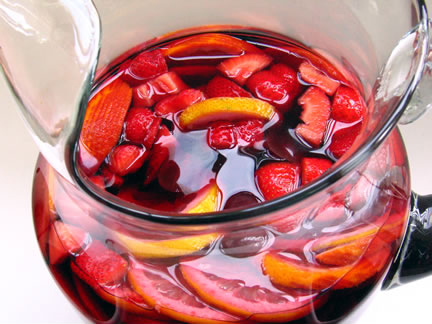
Rosé Sangria
Adapted from Bobby Flay’s Boy Gets Grill
Ingredients
1 bottle (750 ml) dry rosé, preferably Spanish or French
1 cup orange juice, preferably fresh
1/2 cup brandy
1/2 cup triple sec
1/4 cup simple syrup, or more to taste
3 cups sliced oranges, lemons, limes, apples, and blackberries or blueberries
Ice (optional)
Procedure
1. Combine the wine, orange juice, brandy, triple sec, and simple syrup in a large pitcher. Taste for sweetness, adding more simple syrup if needed. Add half of the fruit and refrigerate for at least 8 hours and up to 24 hours.
2. When ready to serve, strain out the fruit that’s been sitting in the pitcher and discard. Stir in the remaining fruit and serve the sangria straight up or over ice.
Garfield minus Garfield
Here’s a funny, funny blog (and book) where someone has taken Garfield cartoons and digitally removed Garfield himself from the frames, leaving just Mr. Jon Arbuckle himself, and showing how depressed and lonely he must be.

Classical Music in Cartoons
I grew up watching Bugs Bunny, the Roadrunner, and Mickey Mouse. Many of these classic cartoons are now available online and, watching them again, I am reminded of how well they used the music. It occurs to me that this was actually my introduction to classical music. Here are a few of my favorite examples.
The Band Concert, 1935
The music: Rossini’s William Tell Overture. Made before the William Tell Overture became identified as The Lone Ranger’s theme, The Band Concert features bandleader Mickey leading an outdoor performance. While the band plows through the overture, Donald Duck continually interrupts by playing “Turkey in the Straw” on his recorder.
Tom and Jerry in The Hollywood Bowl, 1950
The music: Johann Strauss II’s Die Fledermaus. Tom is the conductor of an orchestra of cats. Naturally, Jerry wants in on the act, and of course, Tom repeatedly shoes him away. Excellent choreography in this one. And both Tom and Jerry look pretty sharp in those tuxes.
A Corny Concerto, 1943
The music: Tchaikovsky’s Piano Concerto #1, Strauss’ Tales from the Vienna Woods and The Blue Danube. Warner Bros. frequently poked fun at Disney, especially considering many animators migrated from Disney to Warner Bros. (and MGM). A Corny Concerto rips on Disney’s Fantasia (see #2), starting with Elmer appearing as an unshaven Stokowski introducing the two segments. The first segment is a wild romp in the Vienna woods with Bugs, Porky and an unnamed dog. The second is more standard fare of a duck protecting a family of swans from a vulture.
The Cat Concerto, 1947
The music: Liszt’s Hungarian Rhapsody #2. The Cat Concerto won the Academy Award for Short Subjects-Cartoons in 1946. Warner Bros. released a nearly identical cartoon the same year, Rhapsody Rabbit, which had many of the same gags. Both MGM and Warner Bros. accused the other of plagiarism, but nothing official came of it. It’s a toss-up as to whether The Cat Concerto or Rhapsody Rabbit is the better cartoon. Also watch Rhapsody in Rivets, an Oscar-nominated Warner Bros. cartoon that features the construction of the “Umpire State Building” while the foreman/conductor leaders the show.
The Rabbit of Seville, 1950
The music: Rossini’s Barber of Seville Overture. Bugs does Rossini in a beautifully timed and written masterpiece. Elmer chases Bugs into a theater. Bugs and an unwilling Elmer act out Rossini’s “Barber of Seville,” with Bugs giving Elmer a full head manicure. Best part: Bugs uses his ears to massage Elmer’s bald head. Some of the lyrics: “Hey you! Don’t look so perplexed/why must you be vexed/can’t you see you’re next? Yes, you’re next. You’re so next!” and this one: “There! You’re nice and clean! Although your face looks like it might have gone through a machine.”
The Sorcerer’s Apprentice, 1940
The music: Dukas’ The Sorcerer’s Apprentice. Fantasia is one of Disney’s greatest films. It’s a safe bet to say that more people saw the segments of Fantasia as one-off cartoons on TV than actually saw the movie in the theater. The best part (and probably best-known) is the Sorcerer’s Apprentice, with Mickey as the apprentice who literally gets in over his head. The rest of the music featured in Fantasia was: Bach’s Toccata and Fugue in D Minor, Tchaikovsky’s Nutcracker Suite, Stravinsky’s The Rite of Spring, Beethoven’s Sixth Symphony, Ponchielli’s The Dance of the Hours, Mussorgsky’s Night on Bald Mountain, and Schubert’s Ave Maria.
What’s Opera Doc? 1957
The music: Wagner’s Ring Cycle. Bugs and Elmer Fudd do Wagner in this Chuck Jones masterpiece. Many people consider this the best Bugs Bunny cartoon of all time. Jones reduces Wagner’s whole Ring saga to 6½ minutes in a hilarious parody — and it’s one of the only times Elmer actually “gets” Bugs. I cannot listen to “Flight of the Valkyries” without hearing Elmer sing, “Kill the wabbit, kill the wabbit, kill the wabbit!”
Our Morning Glory
This morning at about 10:30 am, Amy called me while I was working and told me to “stop what you’re doing, go outside, and look up right now.” Overhead, there was a giant, tubular cloud rolling overhead, almost like a horizontal tornado. I couldn’t leave work, and I didn’t have my camera; it was very disappointing to not go and photograph this event. Fortunately, my budding photographer son James was standing by and took these pictures.


An Arcus Cloud is a low, horizontal cloud formation associated with the leading edge of thunderstorm outflow, or occasionally with a cold front even in the absence of thunderstorms. Depending on the shape they take, they are further classified as Roll or Shelf Clouds. This, I assume, was a Roll Cloud.
According to the Cloud Appreciation Society, these happen when vertical columns of warmer air surge up the middle of storm clouds, while cooler air sinks downwards around them, sometimes, though not always (as was the case this morning), proceeding a thunderstorm, heavy rain, and hail. In certain conditions, this sinking air can hit the ground in such a violent way that it causes a solitary wave of air to advance ahead of the storm. In the middle of this advancing wave of air, a roll cloud can occasionally appear, rotating as it travels.
I did not know this before now, but apparently there is a famous roll cloud called the Morning Glory Cloud, that reliably forms at the end of September and beginning of October every year over the northern outback of Australia. This rolling, windy cloud formation is to glider pilots what the Great Barrier Reef is to divers, and many go there to “cloud surf.”
Here are more pictures of roll clouds, movies of the Morning Glory Cloud, and another site about the same.
“O! It is pleasant with a heart at ease
Just after sunset, or by moonlight skies,
To make the shifting clouds be what you please.”
[Samuel Taylor Coleridge,
Fancy in Nubibus (or the Poet in the Clouds), 1819]
Update:
Someone has posted a YouTube video of the same cloud:
And here are pics of the same cloud from the Inky site.