

Hospital Food
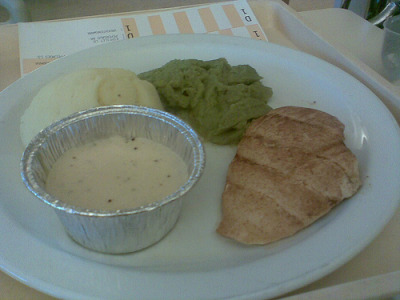
Here’s a link to Hospital Food, a new blog that collects pictures of healthy, healing meals from hospitals from around the world.
RIP ackdoc.com
Today I took down the old ackdoc.com website. It first went live October, 2001. I had a lot of fun with that website. Posted hundreds of new baby pictures. Got thousands of hits. As of today, it has been replaced by this site. I’m going to miss it.
In celebration, here’s a couple of links, remembering the good ol’ days:

The lost art of communication…
I recently wrote a long email to an old friend. We were college roommates, the best of friends, but time (and grownup obligations, and families, and professions, and geography) has gotten in the way, and now months will pass sometimes without us talking. After college, while we were both off pursuing professional degrees, we wrote letters to each other. Funny letters. Silly letters. Letters of substance. I looked forward to these letters, and think I still have most of them saved in a box in the basement.
I miss this. Not just his letters. But letter-writing. Modern technology has not only changed how we communicate, it has weakened our ability to do so. His reply to my recent email said it well:
People don’t…write, or for that matter, even articulate anything well. It’s all about infotransfer—just a sterile efficient passage of the most pedestrian thoughts. I really hate what texting [twittering], etc. is doing to our language and our appreciation for a phrase aptly rendered. Its not just the goofy abbreviations and the super-slangification; I’m most frustrated by how it speeds everything up and pares it down. No one really takes the time or care to say anything well. [My teen son] has taken to saying “brb” (pronounced: “burb”) as in “be right back” when he leaves the room for a second. I told him I have to draw the line when you actually start pronouncing the abbreviations! I bet people’s “working” vocabulary if they were born after 1995 is going to be about a tenth of that of people our age simply because they can’t afford to have too many words for any idea— its like they have small carry-on brains and have to pack as lightly as possible– as few words as possible and preferably short ones. Nuances are an unaffordable luxury and have to go. All that stuff about Eskimos having 100 words for snow is over. I bet modern inuits simply have “sno”.
I used to think that it was a real shame that people had insufficient words to express the profundity or beauty of their thoughts, but now I have a new theory—most people have no profound or beautiful thoughts and so are equipped quite adequately. A bigger shame really. Actually, my real theory revolves around the notion that our vocabulary represents more than the tools by which we articulate our thoughts. I think words are actually the building blocks from which we assemble our thoughts in the first place. If you have no word or symbol or some kind of construct to represent an idea, it seems reasonable that you will have difficulty managing and manipulating that idea in your thoughts and imagination. Therefore, an impoverished vocabulary equals mediocre musings. I tell my grad classes that I will be hard on their written and spoken communication, and that they should take care with their words. I tell them 1) I am convinced that they don’t really know anything until they can articulate it clearly (too many of them think that being familiar with something or recognizing some pertinent ideas when they are presented to you is the same as actually knowing it yourself) and 2) I am not principally concerned with the fact that they are not able to speak well, I am concerned with the fact that they are not able to think well. Being a professor is great because you can climb up on any silly soapbox you own and the entire class at least pretends that they care.
In 2006, the Radicati Group estimated that, worldwide, 183 billion emails were sent per day. Two million each second. By November of 2007, an estimated 3.3 billion Earthlings owned cell phones, and 80% of the world’s population had access to cell phone coverage. In 2004, half a trillion text messages were sent, and the number has no doubt increased exponentially since then. So where amongst this gorge of gabble is there room for the elegant, polite hand-written letter?
I can’t find precise statistics to back this up, but it would seem to me that the hand-written letter is practically extinct. To sit down and write a letter by hand, you have to slow your mind and get into a more contemplative state to precisely chose words to convey nuances of emotion that could never be captured in a quick “Wassup?” And yet nothing expresses respect for another like a letter. No love email, text message or twitter status will ever be carefully bundled into a memory box and savored for years to come.

Further, instinct tells me that there may be something more important going on here. Something causing a quick (if tiny in the whole anthropologic history of things) shift in our evolution, or at least an outbreak of modern mental illnesses like OCD, bipolar disorder, and ADHD.
A recent study found that women who used a cell phone two to three times a day while pregnant had children that were 54 percent more likely to develop ADHD and other behavioral problems. And, if those children used cell phones before age 7, they were 18 percent more likely to develop ADHD.
The authors of the study deny any known causal link, and numerous studies have shown cell phones to be safe. I wonder if these findings have nothing to do with the non-ionizing radio frequency (RF) energy emitted by the devices, and instead if they might be more related to the general lifestyle that involves cell phone use and the modern-day multi-tasking the phones allow. It seems plausible to me that people who have the means and desire to use cell phones regularly are much more likely to heavily use many other forms of modern communication technology like the various social media services and text-messaging. Maybe ADHD is related to growing up in our fast-paced information-saturated, multi-tasking environment.
I want to look into this further. I’m sure there has been more research done regarding this subject. But maybe, just maybe, you can avoid a lifelong Ritalin prescription if you put the cell phone away, turn off the computer, and get out some stationery, a fountain pen, and invest in a monogrammed wax seal. A recent post on the Art of Manliness blog about the lost art of letter writing might be of some help.
Almost No Knead Bread
Nothing smells quite like bread baking in your own oven. But, other than a short-lived bread machine I received as a Christmas gift back in college, I have never really attempted to bake my own. A couple of years ago I saved a bookmark on Mark Bittman’s NYTimes blog “Bitten” for a recipe for “No-Knead Bread” that promised perfect, yet easy to make bread. Basically, it takes time, but little thought.
Today I baked my first loaf, modifying the recipe a little using some guidance from a Cook’s Illustrated magazine article.
And it will not be the last!

“Almost No-Knead Bread”
-
3 cups unbleached all-purpose flour
1/4 teaspoon instant yeast
1-1/2 teaspoons salt
3/4 cup plus 2 tablespoons (7 oz) of room temp. water
1/4 cup plus 2 tablespoons (3 oz) of mild-flavored lager
1 tablespoon white vinegar

The secret to this recipe is using a pre-warmed cast-iron Dutch oven to cook the loaf in after leaving it to rise for 12-18 hours. The original recipe called for the flour, yeast, salt and water only. But some complained that, while easy to do, the flavor lacked a little complexity. Cook’s Illustrated modified the recipe by adding the beer–lager, specifically for reasons related to how this beer is fermented, contains flavor compounds similar to those in the dough starter, and boosts the flavor of the bread–and a little vinegar to add some tanginess.
You start by whisking the flour, yeasty and salt in a large bowl. Then you add the water, beer and vinegar and fold the mixture in with a rubber spatula until a shaggy dough ball forms. Cover it with plastic wrap and let it rise at room temperature for 8 to 18 hours.

Next you lay a sheet of parchment paper over a 10″ skillet and spray it with cooking spray. Transfer the dough to a lightly floured work surface and knead it 10-15 times, shaping it into a ball. Put it seam side down into the skillet and cover it loosely with plastic wrap and let it rise at room temperature again for about two hours. It will have doubled in size and won’t spring back readily when you poke it.

Thirty minutes before you’re ready to cook the loaf, put your oven rack at the lowest level, turn the heat on to 500 degrees and put in the Dutch oven (with lid) to warm up. Once the pot is nice and hot, you lightly flour the top of the bread and cut a 6-inch long, 1/2-inch deep slit in the top of the dough.


Here’s where the parchment paper and skillet does their trick. In order to get the dough down into the dangerously hot Dutch oven, you simply lift it using the parchment paper as a sling and lower the whole thing down into the pot. Replace the lid tightly, put it back into the oven, now lowered to 425 degrees and bake for 30 minutes. At this point, remove the lid and continue to bake until the loaf is deep brown and an instant-read thermometer reads 210 degrees at its center. This will be 20 to 30 minutes longer.
Finally, remove the bread carefully from the pot and transfer it to a wire rack to cool to room temperature, about 2 hours. All the while, standing around staring at it and holding a drool cup under your lips.



A true inspiration

From CBS Evening News, here’s the story of Andy Mackie. After his ninth heart surgery, his doctors had him on 15 different medicines. But the side effects made life miserable. So one day he quit taking all 15 and decided to spend his final days doing something he always wanted to do. He used the money he would have spent on the prescriptions to give away 300 harmonicas, with lessons included. “I really thought it was the last thing I could ever do,” he says.
Inspired bicycles
With a little practice, and maybe some bacon-infused vodka, I think I could do this:
At the feeders…May 2
This morning there are three indigo buntings at the red feeder. Got a new picture of one of them:

And then there’s this little guy. We have several of them. But I do not know what this bird is. Any help?