



Tick-borne Encephalitis
Headlining the Inky today (subscription required) is a story about a Long Island man dying from the Deer-tick Virus. On an island where disease-infested ticks are about as common as the grains of sand underfoot, this story will likely result in new concerns whenever islanders experience otherwise common and non-specific neurologic symptoms like headaches.
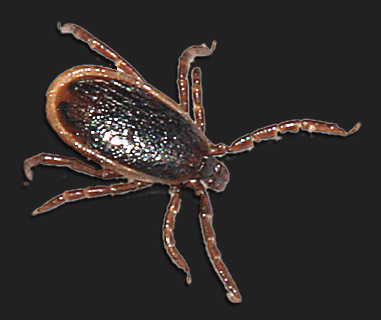
The May 14 issue of the New England Journal reports what might be the first case of a someone dying from an infection with the Deer-tick virus. The 62-year-old man, who apparently also had a history of leukemia/lymphoma died last year of meningoencephalitis, after being bitten by a deer tick infected with deer tick virus.
He presented to the hospital after a 4-day history of fever, fatigue, and a rash on his palms, progressing to stroke-like symptoms of double-vision, slurring his speech, and right-sided weakness.
“This is the first definitive case describing fatal deer tick virus encephalitis in humans,” said Norma P. Tavakoli, lead author of the paper detailing the case. “Deer tick virus encephalitis [inflammation of the brain] is rare, but diagnostic testing is not routinely performed, so there could be cases out there we’re actually missing,” said Tavakoli, who is a research scientist with the Wadsworth Center, New York State Department of Health in Albany.
“It is quite a rare virus,” said Dr. Geoffrey Weinberg, a professor of pediatrics in the division of pediatric infectious diseases at the University of Rochester Medical Center. “I would advise people not to be overly concerned. Ticks are less commonly infected with this than with Lyme disease and, even in Lyme, Conn., a minority of ticks are infected with Lyme disease. Also, the odds are 300-to-one that someone infected with the virus will develop encephalitis. The vast majority have no symptoms at all.”
“Whether or not this will become a real problem, I don’t think anybody knows. Obviously, there is no treatment for the virus so, really, prevention is the only thing you can do,” said Dr. Peter Welch, an infectious disease specialist with Northern Westchester Hospital in Mt. Kisco, N.Y. “We should always be cautious to do our best to not be bitten by ticks.”
Deer tick virus is closely related to Powassan virus, which can also cause encephalitis and is also transmitted by way of the deer tick, according to background information in the study. Both are flaviviruses, a group that includes West Nile virus, St. Louis encephalitis virus, dengue and yellow fever viruses, all of which are transmitted by mosquitoes. In general, encephalitis cases of any sort are few, and labs are not usually able to identify the source, unless it is the herpes simplex virus.
“Since no one has been testing, we really don’t know the incidence of deer tick virus, but it can’t be very high, because we don’t have many cases of encephalitis,” Welch said. “What happens in the future will depend on how many ticks get infected, how easy it is to transmit to people and what percent of people infected get severe disease. It could be that people with normal immune systems are relatively resistant.”

Leave a Reply